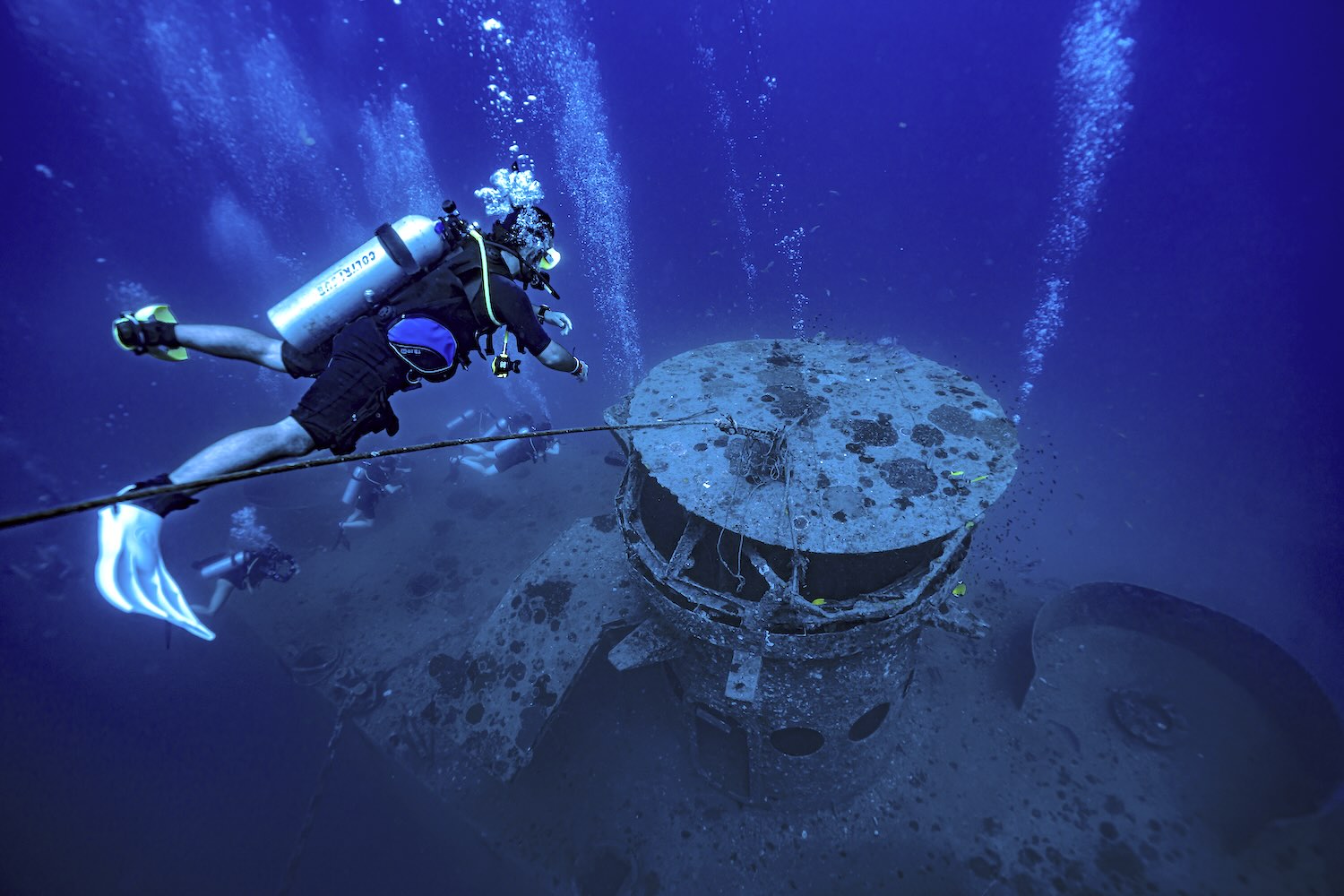
Diving around a wreck is one thing.
Learning how to safely explore inside one is something completely different.
The SSI Advanced Wreck Diving Specialty takes you from exploring the exterior of a wreck to developing the skills, planning and procedures needed for limited wreck penetration.
Across four training dives, you’ll learn the wreck from the outside first, develop your line-handling techniques, practise working with a guideline underwater and finally put everything together on a planned penetration dive.
2 Days | 4 Dives | 7,800 THB
2 Days | 3 Dives | 6,300 THB (Wreck specialty after Advanced Course)
Wreck Diving Specialty
What Is Advanced Wreck Diving?
Wrecks are some of the most exciting environments you can explore underwater.
They have history. Structure. Marine life. And, for suitably trained divers, the opportunity to explore beyond the exterior.
But once you enter a wreck, the dive changes.
You have an overhead above you. Direct access to the surface may no longer be possible. Visibility can change quickly. Navigation becomes more important, and you need a reliable route back to your exit.
That’s why wreck penetration requires specific training.
The SSI Advanced Wreck Diving Specialty develops the skills needed to plan and conduct limited penetration dives using appropriate equipment and a guideline to maintain a continuous route back to open water.
And we don’t start by swimming inside.
We build towards it.
Four Dives. One Progression.
The course is structured so each dive develops the skills you’ll need for the next.
You’ll begin by understanding the wreck itself before working on line handling and penetration techniques.
Only once those foundations are in place do we take the final step inside.
Dive 1 – Map the Wreck
Before you think about entering a wreck, you need to understand it.
Your first dive is spent exploring and mapping the wreck from the outside.
You’ll start identifying its layout, major features, hazards and potential entry and exit points while developing a better understanding of how the wreck sits underwater.
Instead of simply following your instructor around the site, you’ll begin looking at the wreck from the perspective of someone planning a penetration dive.
Where could we enter?
Where could we exit?
What potential hazards can we see?
How would we navigate back here?
The goal is to know the wreck before we start going inside it.
Dive 2 – Learn to Tie In
Now we introduce one of the most important pieces of wreck-diving equipment:
The guideline.
You’ll learn how to prepare and handle a reel, establish secure tie-offs and understand how a line provides a continuous reference back towards your exit.
You’ll practise making primary and secondary tie-offs and managing the reel while maintaining control of your buoyancy, positioning and surroundings.
At this stage, the focus isn’t penetration.
It’s learning to handle the line properly.
Because once you’re inside the wreck, that line matters.
Dive 3 – Put the Line to Work
Now we take those individual skills and start putting them together.
You’ll practise deploying, following and retrieving a guideline while working as part of a team.
The challenge isn’t simply laying a line.
You need to manage the reel while maintaining buoyancy, trim, awareness and communication with your buddy.
You’ll also practise following the line correctly and developing the habits you’ll rely on once there is an overhead above you.
By the end of Dive 3, the individual skills from the course start becoming a complete wreck-diving procedure.
And then we’re ready for the final dive.
Dive 4 – Penetrate the Wreck
This is what we’ve been building towards.
You’ll plan and conduct a limited wreck penetration dive, putting the skills developed across the previous three dives into practice.
You’ll assess the planned route, establish your guideline and enter the wreck while maintaining communication, positioning and awareness of your team.
Inside, you’ll experience a completely different side of wreck diving.
Your focus becomes the line, your buddy, your surroundings, your gas and maintaining a controlled route back towards the exit.
Then you’ll follow your planned route back out into open water.
It’s not about seeing how far inside you can get.
It’s about learning how to enter – and leave – properly.
Why Do We Use a Guideline?
Outside a wreck, if something goes wrong, you can normally ascend towards the surface.
Inside a wreck, you may have an overhead above you.
And the way you came in is the way you need to get back out.
A guideline provides a physical reference connecting the penetration team back towards the exit.
If visibility deteriorates, the wreck becomes disorientating or you simply need to turn the dive, your line gives you a route back towards open water.
Learning how to correctly deploy and follow that line is one of the fundamental skills of wreck penetration.
That’s why we spend two dives developing your line skills before your penetration dive.
Buoyancy Matters Inside a Wreck
Good buoyancy is important everywhere.
Inside a wreck, it becomes essential.
Poor positioning or uncontrolled finning can disturb sediment and dramatically reduce visibility for you and the divers behind you.
You need to be able to maintain your position while managing a reel, monitoring your buddy and staying aware of the environment around you.
This is one reason we’d recommend being comfortable with your buoyancy before starting Advanced Wreck.
If you want to refine your control first, our SSI Perfect Buoyancy Specialty is a great way to prepare.
Wreck Diving on Koh Tao
Koh Tao gives us access to several wrecks, making it a great place to develop your wreck-diving experience.
But wreck diving around the island introduces another consideration:
Depth.
The wrecks we use can sit at depths where your available no-decompression time and existing certification limits become important factors in planning the dive.
For that reason, we strongly recommend completing Deep Diving and Enriched Air Nitrox alongside – or before – your Advanced Wreck training.
Why We Recommend Deep
Your Advanced Wreck certification teaches you how to manage the wreck environment.
Deep Diving teaches you how to manage the depth.
Those are two different areas of training, and when the wreck you’re exploring sits deeper underwater, both become important.
The SSI Deep Diving Specialty develops your planning, awareness and experience for deeper recreational diving and extends your training to a maximum depth of 40 metres.
If your current certification doesn’t allow you to reach the depth of a particular wreck, completing Wreck doesn’t override that depth limit.
That’s why Deep + Wreck makes a natural combination.
Why We Recommend Nitrox
Then there’s time.
You might have plenty of gas remaining and plenty of wreck left to explore — but if your no-decompression limit is getting low, it’s time to move shallower.
On suitable wreck dives, Enriched Air Nitrox can give you more no-decompression time at depth than air.
That can give you more useful time to explore the wreck while remaining within the limits of your dive plan.
Nitrox doesn’t let you dive deeper.
It can help you stay at that depth for longer.
For wreck diving, that’s a very useful tool to have.
Who Can Take the Course?
To join the SSI Advanced Wreck Diving Specialty with Funky Turtle Divers, you’ll need to have at least 12 logged dives.
You should also be comfortable with your buoyancy and general diving skills before beginning penetration training.
Because of the depths of the wrecks we use around Koh Tao, we strongly recommend that students also hold their Deep Diving and Enriched Air Nitrox Specialties.
If you don’t have them yet, speak to us.
We can help you combine your training and build a pathway that makes sense for the wrecks you want to explore.
Advanced Wreck Isn’t About Going as Far Inside as Possible
The attraction of penetration diving is obvious.
But good wreck diving is about judgement, not bravado.
Your training is designed to teach you how to recognise hazards, plan an appropriate route, maintain a continuous guideline, monitor your gas and stay within the limits of your training and the environment.
Sometimes the correct decision is not to enter.
Sometimes it’s to turn around earlier than planned.
And sometimes the best wreck dive is spent exploring the outside.
The aim of the specialty is to give you the skills to make those decisions – and the experience to understand why they matter.
2 Days | 4 Dives | 7,800 THB
2 Days | 3 Dives | 6,300 THB (Wreck specialty after Advanced Course)
Build Your SSI Recognition Levels
Advanced Wreck Diving is a full SSI Specialty certification and can contribute towards your SSI recognition levels as you build your training and logged dive experience.
Combine it with specialties such as Deep Diving, Enriched Air Nitrox and Perfect Buoyancy, and you’ll continue building towards recognition levels including SSI Specialty Diver, Advanced Specialty Diver and Master Diver.
And if you’re thinking about becoming a professional diver, wreck training is another opportunity to develop your buoyancy, navigation, awareness and dive-planning skills beyond standard recreational diving.