
You’ve seen Koh Tao during the day.
Now see what happens when the sun goes down.
As daylight disappears, familiar dive sites transform. Different marine life emerges, colours change under your torch and your attention narrows to the part of the underwater world illuminated in front of you.
The SSI Night & Limited Visibility Specialty teaches you how to plan and confidently dive after dark, while developing skills that are also useful whenever visibility underwater is reduced.
Two night dives. One completely different way to experience Koh Tao.
2 Nights | 2 Dives | 4,800 THB
1 Night | 1 Dive | 3,800 THB (Night specialty after Advanced Course)
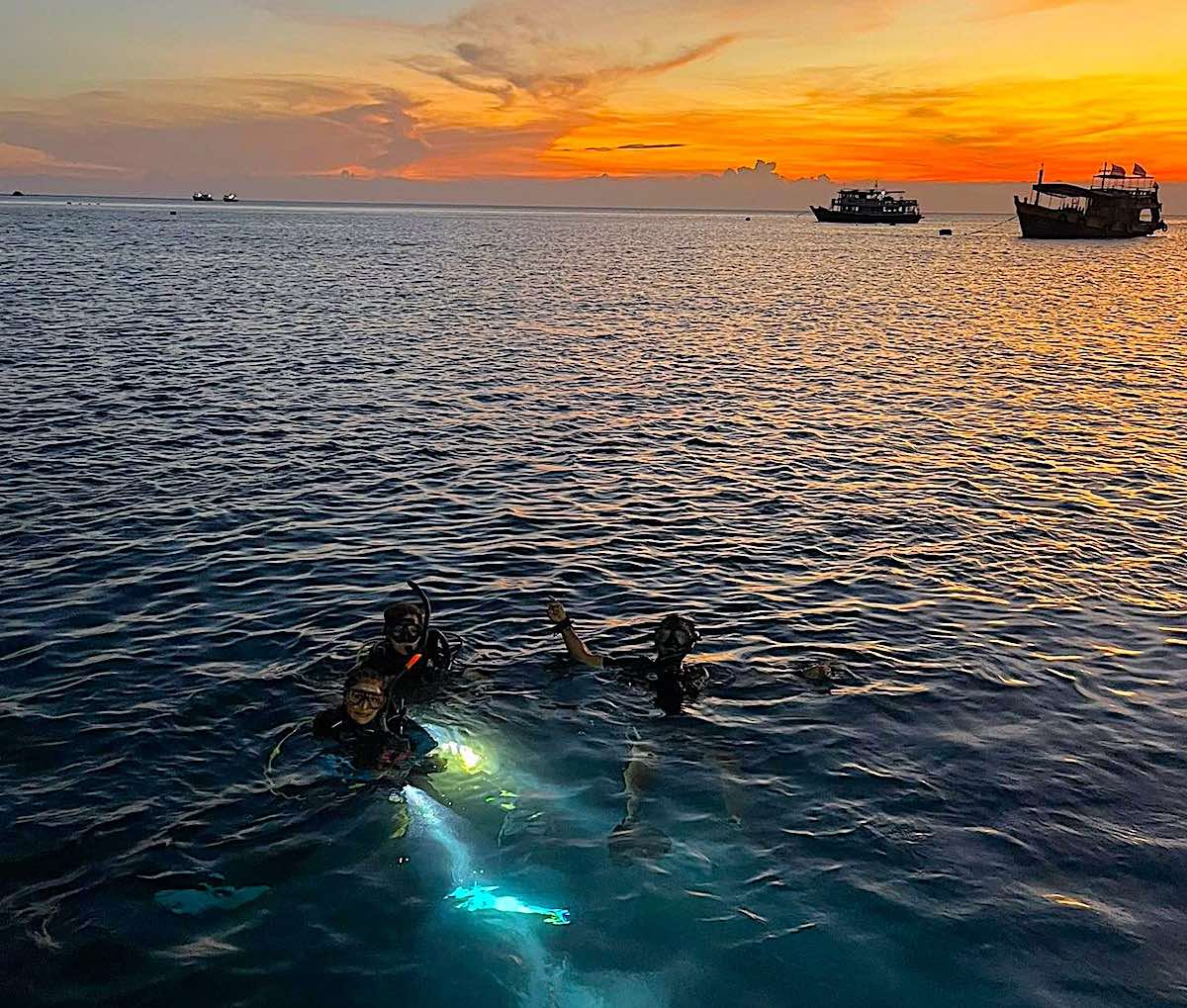
Night Diver Course on Koh Tao
Why Go Night Diving?
Night diving isn’t simply a normal dive with the lights turned off.
The whole experience changes.
During the day, you might be looking across a reef or scanning into the blue. At night, your torch focuses your attention on what’s directly around you.
Small details become easier to notice. Colours come alive under your light. Marine life that spends the day hiding begins to emerge, while some daytime species settle down for the night.
Even a dive site you’ve visited ten times can suddenly feel completely new.
And there’s something pretty special about surfacing after a dive to a dark sky and the lights of Koh Tao in the distance.
What Is the Night & Limited Visibility Specialty?
Diving after dark introduces a few new challenges.
You need to manage your dive light, communicate differently, stay aware of your buddy and maintain your orientation without the visual references you’re used to during the day.
The SSI Night & Limited Visibility Specialty gives you the knowledge and practical experience to manage those challenges safely and comfortably.
You’ll complete the required academics and two open-water training dives, developing your skills across two nights of diving. SSI requires at least two open-water training dives for certification.
Two Dives After Dark
Your specialty includes two night dives, giving you the chance to build your confidence rather than experiencing night diving just once.
On your first dive, much of the focus is naturally on getting comfortable.
You’ll learn how to use your torch effectively, communicate using light signals, stay close to your buddy and maintain awareness of your surroundings.
By the second dive, the environment already starts to feel more familiar.
You can spend less time thinking about the fact that it’s dark and more time actually enjoying what’s happening around you.
That’s where night diving gets really good.
Learn to Use Your Dive Light
Your torch becomes one of your most important pieces of equipment at night.
It’s how you see.
It’s how you communicate.
And it’s part of how you maintain awareness of your buddy and surroundings.
During the course, you’ll learn how to use your primary light effectively, communicate with light signals and understand what to do if a light fails.
You’ll also look at appropriate night-diving equipment and how to prepare it before getting in the water.
SSI’s Night & Limited Visibility training specifically covers dive lights, communication, navigation and the procedures needed to safely manage dives in darkness or reduced visibility.
Communication After Dark
Your buddy might not be able to clearly see your hand signals at night.
So how do you communicate?
You’ll learn how to use your torch to make communication easier, illuminate hand signals and get your buddy’s attention without shining a bright light straight into their eyes.
These techniques quickly become natural and help you stay connected with your buddy throughout the dive.
Navigate When Everything Looks Different
Navigation becomes more challenging when your field of vision is limited to what your torch can illuminate.
A dive site you know well during daylight can feel very different after dark.
You’ll develop techniques for maintaining your orientation, using your compass and natural references, and keeping track of where you are throughout the dive.
It’s useful training even if you don’t plan to become a regular night diver.
Limited visibility can happen during the daytime too.
Night Diving Is Also Limited Visibility Diving
The full SSI program is called Night & Limited Visibility for a reason.
Many of the skills you develop at night are also valuable when visibility is reduced during daylight hours.
Silt, plankton, weather and environmental conditions can all reduce underwater visibility.
Learning to remain calm, navigate, maintain buddy contact and communicate effectively when you can’t see very far in front of you makes you a more adaptable diver in a wider range of conditions.
Meet Koh Tao’s Night Shift
One of the best reasons to night dive is simply to see what comes out after dark.
As the daytime reef settles down, the behaviour underwater changes.
Creatures that spend daylight hours tucked into cracks and hiding beneath coral become more active, while other marine life behaves completely differently as night falls.
Instead of covering as much distance as possible, night dives often become about slowing down.
Point your torch into the reef.
Look into the gaps.
Take your time.
There’s a whole side of Koh Tao’s underwater world that you don’t see during the day.
See the Real Colours of the Reef
There’s another reason diving with a torch is interesting.
Water absorbs different wavelengths of light as you descend, which is why colours – particularly reds and oranges – disappear with depth.
At night, your dive light becomes the main light source.
Shine your torch onto coral or marine life and suddenly those colours appear again right in front of you.
It’s one of those little things that makes a familiar reef look completely different.
Who Is This Course For?
You don’t need to be an advanced diver to start exploring after dark.
SSI’s Night & Limited Visibility Specialty can be completed once you’re an Open Water Diver or equivalent, and the minimum age is 10 years old. The program has a maximum training depth of 30 metres for adult divers, although your existing certification depth limits still apply.
So if you’ve recently completed your Open Water and night diving is something you want to experience, you don’t need to complete Advanced Open Water first.
Go straight into the full specialty and learn it properly.
Night Specialty or an Adventure Dive?
If you complete a Night & Limited Visibility adventure dive as part of Advanced Open Water, you’re getting an introduction to this type of diving.
The full Night & Limited Visibility Specialty goes further.
Instead of one experience dive, you’ll complete the full academic training and two open-water training dives required for the specialty certification.
If you know night diving is something you want to do, we’d recommend taking the full specialty.
2 Nights | 2 Dives | 4,800 THB
1 Night | 1 Dive | 3,800 THB (Night specialty after Advanced Course)
Build Your SSI Recognition Levels
Night & Limited Visibility is a full SSI Specialty and can contribute towards your SSI recognition levels as you build your training and logged diving experience.
Complete additional specialties and dives and you can progress through SSI’s recognition pathway, including Specialty Diver, Advanced Specialty Diver and Master Diver.
It’s also particularly useful if you’re thinking about Going Pro.
Night & Limited Visibility training or qualifying experience is part of the experience requirements within SSI’s professional pathway, so it’s a valuable area to develop before Divemaster.